


Henri Chapron (30 December 1886 - 14 May 1978) was a prominent French automobile coachbuilder. His atelier, created in 1919, was located in the Paris suburb of Levallois-Perret.
Chapron was born in Nouan-le-Fuzelier (Sologne), and began his career developing custom body designs for French luxury vehicles, like Talbot, Delage, and Delahaye, in the 1920s.
France ceased building vehicles of this type in the 1950s, due to tax legislation that made luxury vehicles prohibitively expensive in France (see Tax horsepower#France).
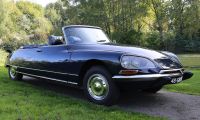
Chapron switched his attention to the recently launched Citroën DS. Chapron’s first rebodied DS coupe was the 1958 Le Paris. [2] At first, Chapron purchased these vehicles and customised them as one-off creations. Many of these became unique convertible variants. His DS convertible caused a sensation at the 1958 Motor Show. Citroën managers came to see him in Levallois to offer him a production agreement. For 2 years, the Chapron and Citroën teams worked hand in hand in order to strengthen the safety standards on the car and to minimize the cost of production. On the basis of a design by DS designer Flaminio Bertoni, Chapron developed a two-door convertible body that was sold through the Citroën dealer network. The Series convertible was presented at the 1960 Paris Motor Show.

The official collaboration with Citroën began in 1961. A news item in the 20 July 1961 Daily Variety noted that Cary Grant had "telephoned the French automotive company, Citroën, to order a new car for use in the film" That Touch of Mink.
The factory reportedly shipped “the display model” to the studio without hesitation and the car is prominently featured in the film, garnering key publicity for the model.
Chapron built this "Décapotable usine" (factory convertible) - 1,365 cars in all. This allowed buyers to benefit from a factory warranty on Usine convertibles purchased. The factory convertibles used a DS platform supplied by Citroën, which included all of the mechanics, front fenders, windshield and wheels. Chapron used the full chassis, but reinforced various elements in the floor area. The doors of the standard sedan have been lengthened by 18 cm; Chapron remade the rear fenders.
Chapron continued making his own DS based vehicles, including the Croisette, Palm Beach, Le Dandy, Lorraine, and Le Leman. Unlike the factory convertibles, Chapron usually used a six centimeter lower windshield for his own models. The side windows - including the rear ones - could be lowered manually or electrically, unlike the factory car. A trained salesman and connoisseur, Henri Chapron wanted the finest leathers. While Citroen bought its leathers from Costil in Pont Audemer, Chapron ordered his from Connolly in England.

In 1968, Chapron made a special extended DS Presidential model for the government of Charles de Gaulle.
In 1972, Chapron delivered two SM Presidential models to the government of Georges Pompidou. These gigantic 4 door convertibles were first used for the 1972 visit of Queen Elizabeth II to France and continued in use through the inauguration of Jacques Chirac in 1995.[7] The Presidentielle was pressed into service again in 2004, when Queen Elizabeth II reviewed troops on the Champs Elysees with Chirac 5 April 2004, at the start of the queen's three-day state visit to France to mark 100 years of formal friendship between France and Britain. The Entente Cordiale, signed in London on April 8, 1904, resolved a number of colonial disputes and helped to forge an alliance against a resurgent Germany.
The Citroën SM Mylord was designed as a two-door full convertible - i.e. without a roll bar. It was given a notchback body with a small trunk lid, which at the rear end authentically took up the design of the original vehicle - especially the raised license plate. The prototype of the Mylord was presented at the Paris Motor Show in 1971, and sales began a year later. The production was complex.
Chapron received a standard body shell from Chausson. The technology and the floor pan of the SM Coupé remained essentially unchanged; the wheelbase was also retained. The B and C pillars were removed, after which Chapron installed extensive reinforcements in the body area. The modified body was transported to Citroën, where the engine, chassis and other technical components were installed.
Finally, the car was brought back to Chapron's workshop to do the interior and paint it. Overall, only a few Mylord convertibles were made; the sources vary between seven and eight copies. What is certain is that four vehicles were sold in France; two more went to Spain, one to the United Kingdom.






















































































































































































 LINKS E SITES IMPORTANTES


