


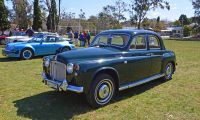
The Rover P4 series is a group of mid-size luxury saloon cars produced by the Rover Company from 1949 until 1964. They were designed by Gordon Bashford.
Their P4 designation is factory terminology for this group of cars and was not in day-to-day use by ordinary owners who would have used the appropriate consumer designations for their models such as Rover 90 or Rover 100.
Production began in 1949 with the 6-cylinder 2.1-litre Rover 75. Four years later a 2-litre 4-cylinder Rover 60 was brought to the market to fit below the 75 and a 2.6-litre 6-cylinder Rover 90 to top the three-car range. Several variations followed.
These cars are very much part of British culture and became known as the 'Auntie' Rovers.[3] They were driven by royalty including Grace Kelly.
The P4 series was supplemented in September 1958 by a new conservatively shaped Rover 3-litre P5 but the P4 series stayed in production until 1964 and their replacement by the Rover 2000.
The earlier cars used a Rover engine from the 1948 Rover 75. A four-speed manual transmission was used with a column-mounted gear change at first and floor-mounted unit from September 1953. At first the gearbox only had synchromesh on third and top but it was added to second gear as well in 1953. A freewheel clutch, a traditional Rover feature, was fitted to cars without overdrive until mid-1959,[4] when it was removed from the specifications, shortly before the London Motor Show in October that year.
The cars had a separate chassis with independent suspension by coil springs at the front and a live axle with half-elliptical leaf springs at the rear. The brakes on early cars were operated by a hybrid hydro-mechanical system but became fully hydraulic in 1950. Girling disc brakes replaced drums at the front from October 1959.

The complete body shells were made by the Pressed Steel company and featured aluminium/magnesium alloy (Birmabright) doors, boot lid and bonnets. If the handle was not used to close them they were easily dented so for the final 95/110 models steel was used instead. The P4 series was one of the last UK cars to incorporate rear-hinged "suicide" doors.
After four years of the one model policy Rover returned to a range of the one car but three different sized engines. In September 1953 it announced it would supply a four-cylinder Rover 60 and a 2.6-litre Rover 90 adding them to the 75's 2.1-litre six. Rover's stated intention was "to cater for a wider field of motorists who require a quality car with varying degrees of economical running costs and performance".[8]
On the same day there were modifications announced which were accordingly shared by all three:
a curved central gear change lever. This was Rover's response to the dislike of many motorists for the steering column gear change with its complex linkages. The shape of the new lever still allowed three people to make use of the front bench seat.
parking lights were mounted on top of the front mudguards, the disused apertures below were used for reflectors – and later for traffic indicators.[8]
Rover also announced an all-round reduction in Rover and Land-Rover prices.[8] This was a response to a slump in both home and export sales of all British cars.[11]
The 2.103 litres (128.3 cu in) IOE engine continued.













































































































































































 LINKS E SITES IMPORTANTES


