


The MGA was born out of two strands of activity; one was the American’s discovery of British sports cars in the years after the Second World War with the car responsible for that being the MG TC of 1945-1950.
The second was MG’s quest to be recognized as a serious sports car maker which meant that the company needed to be involved in motorsport and such things as setting speed and endurance records.
The economic pressures led Morris along with the M.G. Car Company to join together with the Austin Motor Company in 1952 to form British Motor Corporation. This merger led to product rationalization with many Austin and Morris car models being largely identical save for the badges on them. This was referred to as “Badge engineering” and it served to keep the Austin, Morris, Wolseley, Riley, and MG brand names alive.
There was however a real risk that the MG as a sports car would be made to disappear. The MG Magnette sedan was updated in 1953 to be a remodeled Wolseley, and the successors to the MG TC, the MG TD, and MG TF were becoming as old fashioned as the British Morgan and in dire need of post-war modernization – but there was scant money or motivation available to create a new car.
The major obstacle to the development of a new MG occurred because of the 1952 merger between Austin and Morris/MG. Leonard Lord of Austin had attempted to create a car specifically aimed at the American market.
But instead of being a sports car oozing character and excitement the car that Austin’s boffins created was the Austin A90 Atlantic: a car so awkward looking that only its creator could love it, a car that didn’t so much accelerate as “gain momentum”.
The Austin Atlantic had been an unmitigated disaster and by 1952 Austin’s Leonard Lord was rather desperate to find a real sports car with which to wow the Americans and save his company.
It was as he wandered from stand to stand at the 1952 London Earls Court Motor Show that Leonard Lord had seen the car that could save his company. The car was at the stand of the Donald Healey Motor Company, it was made using predominantly Austin parts, and it was drop dead gorgeous.
It was so gorgeous that French actor and singer Sacha Distel would later buy one and use it to chauffeur actress Brigitte Bardot around.
THE DEVELOPMENT OF THE MGA
Despite its old fashioned looks the MG TD of 1950 was a fairly advanced sports car. It had an independent front suspension with coil springs, rack and pinion steering, and its engine was an MG XPAG 1,250cc OHV producing 57 bhp at 5,500 rpm.
This was the basis on which MG’s Chief Designer Syd Enever built a streamlined body for the 1951 24 Hours Le Mans motor race. This car was given project designation “EX176” and is typically referred to by its registration number UMG 400.

The Le Mans car proved to be so inspiring that two new chassis were created for a prototype future production car to replace the rather “old school” MG TF, and one of those was developed into a full road registered test car.
These two were designated “EX175” and the road registered test car was HMO 6. The new chassis was necessitated by limitations of the original MG TF chassis which placed the driver’s seating position up quite high, something that was not a problem in the MG TF but something that was a problem in a streamlined Le Mans car for which getting the driver’s seat lower was needed both to improve the car’s aerodynamics and lower the center of gravity.
The new chassis had its side members placed further apart so the driver’s seat could sit between them, and thus sit much lower. This meant that the cockpit floor was attached to the bottom of the chassis members instead of on top of them as in the MG TF.
The new prototype was just as “drop dead gorgeous” as the Austin-Healey 100/4 but with the 1952 merger with Austin and their desire to push ahead with that car the going got rough for the prospects of a new MG sports car.
What tipped the scales was a precipitate nosedive in sales of the MG TF by 1953 that brought about a “something must be done because we’re losing lots of money” motivation factor that management were forced to act on. The new car was to be called the MGA, because it was to be the first of a new modern post-war breed of MG.
The new car did have features that originated from the Austin merger however. The MG T series XPAG engine was done away with and instead the MGA was fitted with an Austin B series inline four cylinder of 1,489cc capacity breathing through twin SU H4 carburetors producing 68hp.
This was improved on to give the engine 72hp fairly soon after production commenced. This engine was the same as the one used in the badge engineered Wolseley derived MG Magnette saloon/sedan with which the MGA shared many common parts.

The front suspension was independent with wishbones and coil springs at the front and a traditional semi-elliptic leaf springs with live axle at the rear. The steering was by rack and pinion, much preferred by sports car enthusiasts, just as had been used on the MG T series cars: brakes were Lockheed drums front and rear.
So the end result was an aerodynamic car with head turning modern looks and subtle engineering improvements that was just as much fun to drive as its predecessors: it looked completely new, but it drove like an improved “real MG”.
The new MGA 1500 tried hard to make “the ton” (i.e. 100mph) and almost made it with top speed on test being 97.8mph. Standing to 60mph time was 16 seconds and fuel consumption a modest 26.7 miles to the Imperial gallon (22mpg – US gallons).
The car made its debut in 1955 and was priced at £844 with taxes included. The first production cars were made as roadsters with the option of a detachable hard top. However BMC quickly also introduced a fixed head coupe complete with wind-up windows and good weatherproofing.
The coupe model was sold as an alternative style of car for the entire production run of the MGA and there were coupes produced of all models including the Twin Cam.
MGA
A BRIEF HISTORY OF THE MGA – EVERYTHING YOU NEED TO KNOW
Reading time: about 15 minutes.
BRIEF HISTORIESBRITISHCARSCLASSIC CARS
THE MGA – AN INTRODUCTION + BACKGROUND
The MGA was born out of two strands of activity; one was the American’s discovery of British sports cars in the years after the Second World War with the car responsible for that being the MG TC of 1945-1950.
The second was MG’s quest to be recognized as a serious sports car maker which meant that the company needed to be involved in motorsport and such things as setting speed and endurance records.
MGA Twin Cam
In the post World War II years the British Government faced a dire economic situation resulting from not just one world war, but two world wars with an economic depression sandwiched in between them.
The upshot of this for the British automotive industry was that they needed to create products for export so the nation could recover financially, and not only that but the steel required for production was rationed by the government with preference given to export products, so to manufacture anything an industry needed to be willing to “export or perish”.
The economic pressures led Morris along with the M.G. Car Company to join together with the Austin Motor Company in 1952 to form British Motor Corporation. This merger led to product rationalization with many Austin and Morris car models being largely identical save for the badges on them. This was referred to as “Badge engineering” and it served to keep the Austin, Morris, Wolseley, Riley, and MG brand names alive.
There was however a real risk that the MG as a sports car would be made to disappear. The MG Magnette sedan was updated in 1953 to be a remodeled Wolseley, and the successors to the MG TC, the MG TD, and MG TF were becoming as old fashioned as the British Morgan and in dire need of post-war modernization – but there was scant money or motivation available to create a new car.
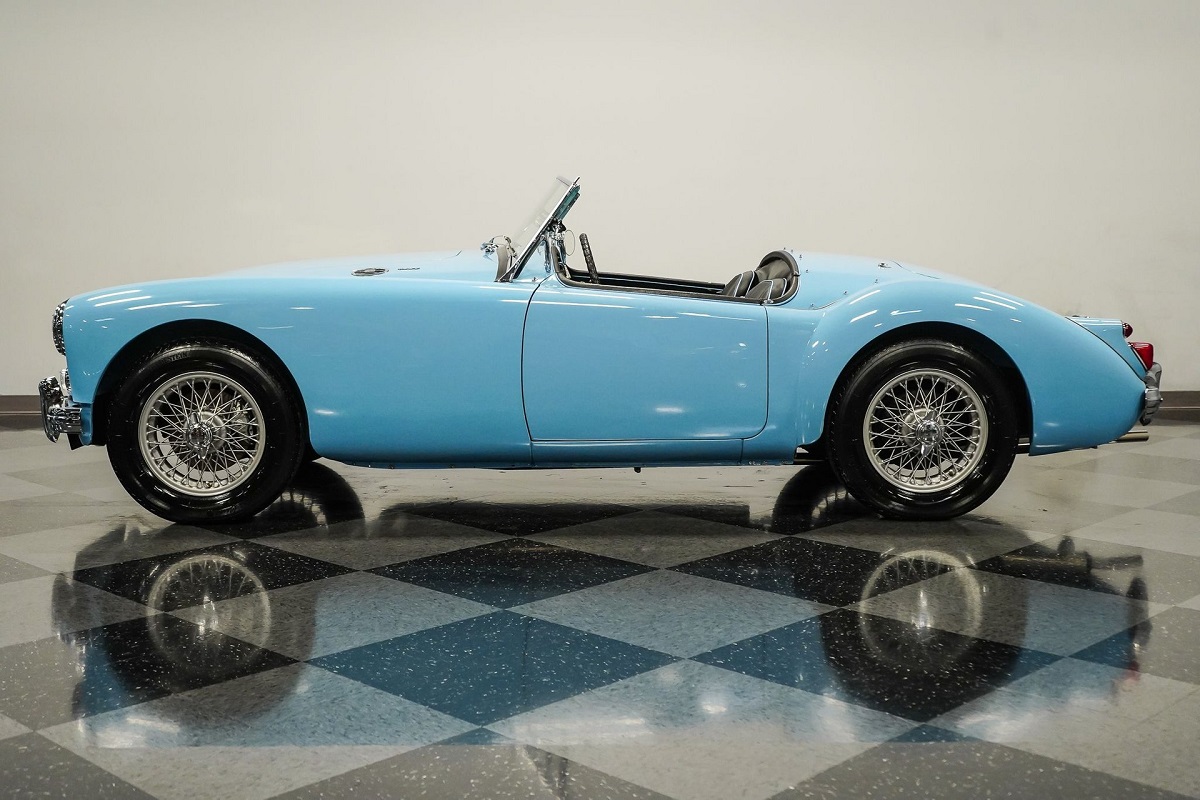
MGTF roadster sports car
The major obstacle to the development of a new MG occurred because of the 1952 merger between Austin and Morris/MG. Leonard Lord of Austin had attempted to create a car specifically aimed at the American market.
But instead of being a sports car oozing character and excitement the car that Austin’s boffins created was the Austin A90 Atlantic: a car so awkward looking that only its creator could love it, a car that didn’t so much accelerate as “gain momentum”.
The Austin Atlantic had been an unmitigated disaster and by 1952 Austin’s Leonard Lord was rather desperate to find a real sports car with which to wow the Americans and save his company.
Austin A90 Atlantic car convertible
The Austin A90 Atlantic – A sales failure and a car with a divisive design.
It was as he wandered from stand to stand at the 1952 London Earls Court Motor Show that Leonard Lord had seen the car that could save his company. The car was at the stand of the Donald Healey Motor Company, it was made using predominantly Austin parts, and it was drop dead gorgeous.
It was so gorgeous that French actor and singer Sacha Distel would later buy one and use it to chauffeur actress Brigitte Bardot around.
Leonard Lord and Donald Healey Healey sports car
Leonard Lord (left) and Donald Healey (right) at the 1952 London Earls Court Motor Show in a Healey 100.
Leonard Lord and Donald Healey came to a mutually beneficial agreement over dinner that night and the Austin-Healey was born. That was good news for Leonard Lord and Austin, and good news for Donald Healey, but very bad news for MG and any hopes they had for producing a new MG sports car for the post-war era.
A new, modern looking MG sports car would be a direct competitor to the Austin-Healey and so senior management would be unlikely to support it.
THE DEVELOPMENT OF THE MGA
Despite its old fashioned looks the MG TD of 1950 was a fairly advanced sports car. It had an independent front suspension with coil springs, rack and pinion steering, and its engine was an MG XPAG 1,250cc OHV producing 57 bhp at 5,500 rpm.
This was the basis on which MG’s Chief Designer Syd Enever built a streamlined body for the 1951 24 Hours Le Mans motor race. This car was given project designation “EX176” and is typically referred to by its registration number UMG 400.
MG racing car UMG400
The Le Mans car proved to be so inspiring that two new chassis were created for a prototype future production car to replace the rather “old school” MG TF, and one of those was developed into a full road registered test car.
These two were designated “EX175” and the road registered test car was HMO 6. The new chassis was necessitated by limitations of the original MG TF chassis which placed the driver’s seating position up quite high, something that was not a problem in the MG TF but something that was a problem in a streamlined Le Mans car for which getting the driver’s seat lower was needed both to improve the car’s aerodynamics and lower the center of gravity.
The new chassis had its side members placed further apart so the driver’s seat could sit between them, and thus sit much lower. This meant that the cockpit floor was attached to the bottom of the chassis members instead of on top of them as in the MG TF.
MGA prototype EX175 HMO6
The new prototype was just as “drop dead gorgeous” as the Austin-Healey 100/4 but with the 1952 merger with Austin and their desire to push ahead with that car the going got rough for the prospects of a new MG sports car.
What tipped the scales was a precipitate nosedive in sales of the MG TF by 1953 that brought about a “something must be done because we’re losing lots of money” motivation factor that management were forced to act on. The new car was to be called the MGA, because it was to be the first of a new modern post-war breed of MG.
The new car did have features that originated from the Austin merger however. The MG T series XPAG engine was done away with and instead the MGA was fitted with an Austin B series inline four cylinder of 1,489cc capacity breathing through twin SU H4 carburetors producing 68hp.
MG MGA Twin Cam
This was improved on to give the engine 72hp fairly soon after production commenced. This engine was the same as the one used in the badge engineered Wolseley derived MG Magnette saloon/sedan with which the MGA shared many common parts.
The front suspension was independent with wishbones and coil springs at the front and a traditional semi-elliptic leaf springs with live axle at the rear. The steering was by rack and pinion, much preferred by sports car enthusiasts, just as had been used on the MG T series cars: brakes were Lockheed drums front and rear.
So the end result was an aerodynamic car with head turning modern looks and subtle engineering improvements that was just as much fun to drive as its predecessors: it looked completely new, but it drove like an improved “real MG”.
MG MGA Twin Cam Wheels
The new MGA 1500 tried hard to make “the ton” (i.e. 100mph) and almost made it with top speed on test being 97.8mph. Standing to 60mph time was 16 seconds and fuel consumption a modest 26.7 miles to the Imperial gallon (22mpg – US gallons).
The car made its debut in 1955 and was priced at £844 with taxes included. The first production cars were made as roadsters with the option of a detachable hard top. However BMC quickly also introduced a fixed head coupe complete with wind-up windows and good weatherproofing.
The coupe model was sold as an alternative style of car for the entire production run of the MGA and there were coupes produced of all models including the Twin Cam.
Le Mans MGA race cars Abingdon
To make the MGA’s debut an event that would cause the sports car enthusiasts to take notice four cars were to be built, three to compete and one spare car prepared as entries in the 1955 24 Hours Le Mans. This group of cars were given the company designation EX182 and three competed in the race with one crashing and the other two finishing in 12th and 17th places.
That success was however clouded by the accident at the 1955 Le Mans which led to horrendous casualties when a car crashed at the end of the high speed Mulsanne Straight sending parts of the car including its engine and transmission hurtling through a spectator grandstand.

























































































































































































 LINKS E SITES IMPORTANTES


