


The Vauxhall Viva is a small family car that was produced by Vauxhall in a succession of three versions between 1963 and 1979. These were designated as the HA, HB and HC series.
The Viva was introduced a year after Vauxhall's fellow GM company Opel launched the Opel Kadett A. Both cars were a result of the same General Motors project and share the same floorpan and engine constructions, but with one main difference being the use of metric measurements for the Opel and imperial ones for the Vauxhall. They are also visually similar, however few components are interchangeable and the cars are thus not "sister models" or versions of one another.
A van version was also produced, as the Bedford HA. In the UK the Viva's principal competitors at the time of its launch included the well-established Ford Anglia and Morris Minor.
The third generation HC series was the last solely Vauxhall designed passenger car when it ceased production in 1979, since all future Vauxhalls would be badge engineered Opel models.
The HB Viva, announced in September 1966[10] and sold by Vauxhall until 1970, was a larger car than the HA, featuring coke bottle styling, and was modelled after American General Motors (GM) models such as the Chevrolet Impala/Caprice of the period. It featured the same basic engine as the HA, but enlarged to 1,159 cc, but with the added weight of the larger body the final drive gearing was reduced from 3.9 to 1 to 4.1 to keep the nippy performance (except the SL90 which retained the 3.9 diff having the power to cope with the higher ratio).
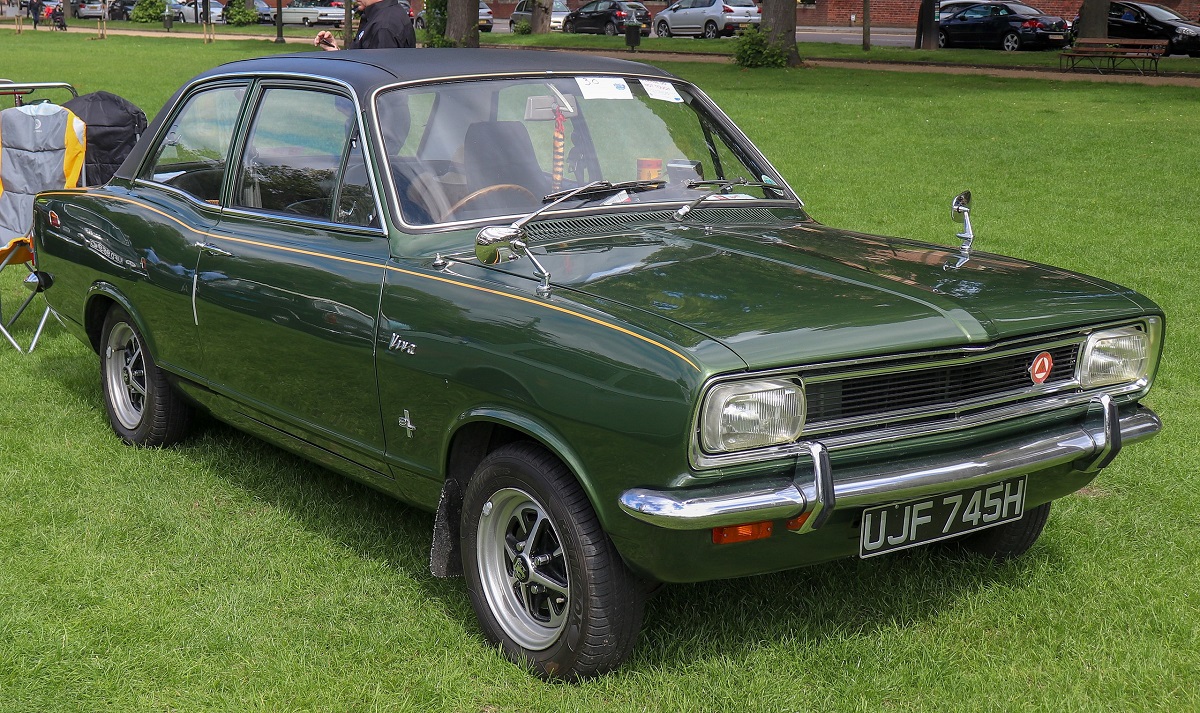
The automatic Viva HB was offered from February 1967, and fitted with the ubiquitous Borg Warner Type 35 system. Cars of this size featuring automatic transmission were still unusual owing to the amount of power the transmission systems absorbed: a major British motoring journal later described Viva HBs with automatic transmission as "among the slowest cars on the road".
The HB used a completely different suspension design from the HA, having double-wishbone and coil springs with integrated telescopic dampers at the front, and trailing arms and coil springs at the rear. Lateral location and anti-squat of the rear axle was achieved using upper trailing arms mounted at approximately 45° fixed to lugs at the top of the differential. Both front and rear could also be fitted with optional anti-roll bars. The HB set new standards for handling in its class as a result of the adoption of this suspension design, where many of its contemporaries stuck with leaf springs and MacPherson struts.
This time, apart from the standard and 90 stages of tune, there was also, for a brief time, a Brabham SL/90 HB that was purported to have been developed with the aid of world racing champion Jack Brabham. Brabham models were marked out externally by distinctive lateral black stripes at the front of the bonnet that curved down the wings and then headed back to end in a taper at the front doors. This model is almost impossible to find today. This model and the Viva GT are the two most sought after models made. The Brabham model differed from the standard Viva SL/90 in having a different cam-shaft, uprated suspension with anti-roll bars, different exhaust manifolds, and a unique twin-carb manifold, as well as differing interior trim. The Viva GT had substantially different engine and running gear and interior from the standard Viva HB models. It was distinguished by having a black bonnet with twin louvres and being all-over white. Later GTs came in different colours.
Two larger overhead camshaft engines from the larger Vauxhall Victor were also offered – a twin carb 1975 cc in the Viva GT from Feb 1968 and a 1599 cc making up the Viva 1600 from May 1968.

With the expanded engine programme, the HB saw numerous permutations of model offerings, with base, deluxe and SL trims offered with a choice of standard 1.2, tuned 90 1.2, Brabham 90 1.2 and the aforementioned overhead cam units offered during its run. The Brabham was effectively replaced by the 1600, although many complained of high fuel consumption with this engine. Front disc brakes came with the 90 and overhead cam engine models, while a larger 12 gallon fuel tank was also part of the 1600 and GT package.
The brakes were problematic: a 1971 survey of passenger cars registered in Sweden during 1967 place the HB Viva at the top of a list of cars identified as having faulty brakes as part of an annual testing procedure.
Problems were concentrated on uneven braking and dragging brakes, generally at the rear, and affected 26% of the cars tested.

Second on the list, with 24% of cars triggering brake fault reports, was the similarly configured Opel Kadett estate.[11] Although it avoided the bottom spot in other individual categories, the poor score achieved by the brakes left the Viva with the highest overall rate of failure of the 34 passenger cars included in sufficient numbers to feature in the reports of the Swedish test results.
Originally offered as just a two-door saloon, a three-door estate joined the HB range in June 1967,[9] but the advent of the four-door in October 1968 saw the HB breaking sales records worldwide. The introduction of the four-door option coincided with various minor improvements to the interior trim, while 'auxiliary' switches were relocated from a remote panel to positions nearer to the steering wheel.
The GM "energy absorbing" steering column was now fitted to all models and the fuel tank capacity was increased from 8 to 12 British gallons (36 to 55 litres).
The 4-door saloon was designed and engineered by Holden in Australia who exported it as a kit of parts back to Vauxhall in England.
In the later 1960s and early 1970s, Britain's Motor magazine polled readers about their cars: they included a poll of HB Viva 1600 owners. The answers given greatest prominence were to the final question which asked whether or not respondents would buy another car of the same model: just 21% of Viva 1600 owning respondents answered "yes", which was the lowest score for this question achieved by any of the first seventeen models for which surveys were conducted.

By the time of the readership poll, the HB Viva was within a year of being replaced even though the 1600 version itself had only been offered since 1968, so the sample will have been relatively small: it appears that the low satisfaction rate may have reflected not so much the car's design but rather a lack of effective quality control in the manufacturing processes.
A van version of the Viva HB was developed, but it never got beyond the prototype/mock-up stage. However, General Motors New Zealand did sell versions of the three-door station wagon with no rear seat as 'van' models and continued this with the later HC version.
Aftermarket conversion specialists, Crayford, also ran off some convertibles based on the 2-door Viva. Very few of these conversions exist still, only two GT model HBs were converted, but both are known to survive, and will likely be on the show scene in the coming years.


 LINKS E SITES IMPORTANTES


