

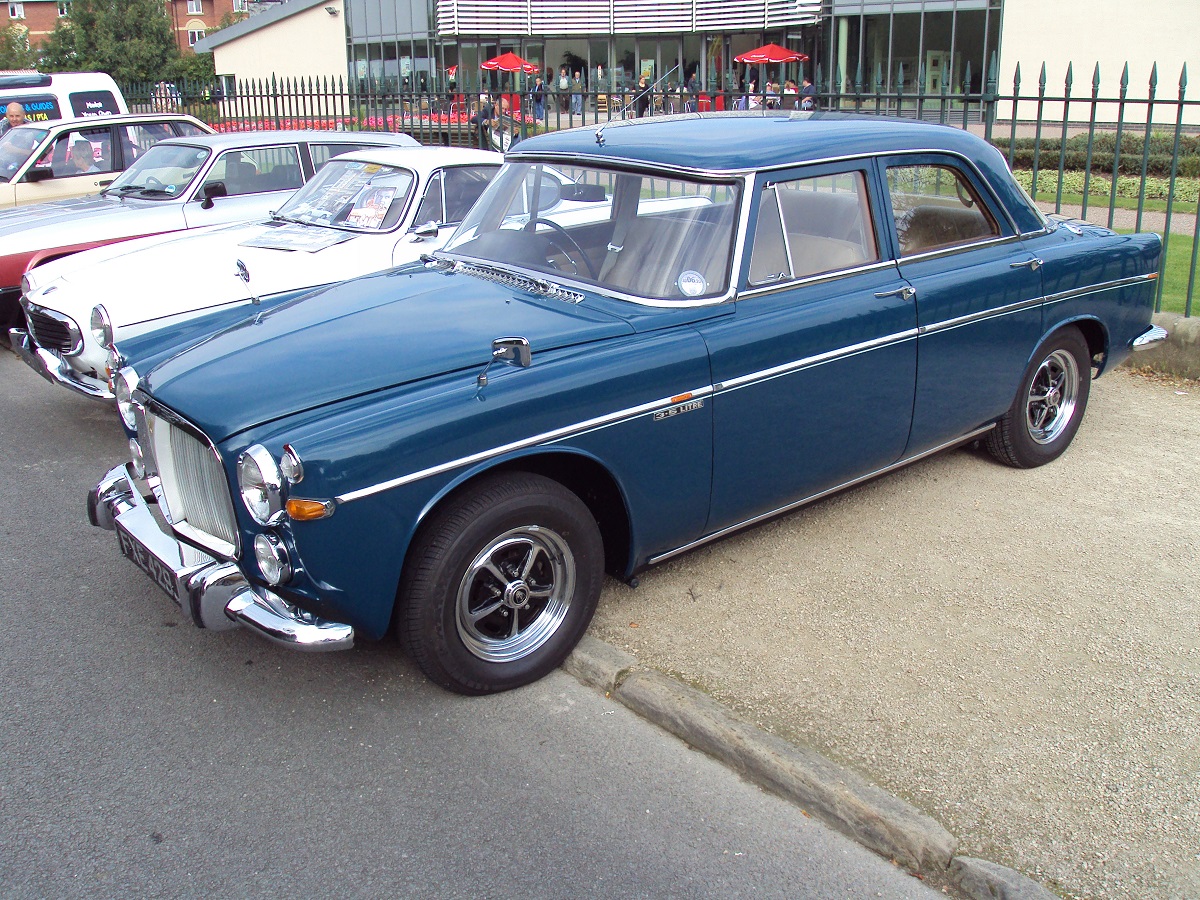
The final iteration of the P5 appeared in September 1967. Now powered by the 3,528-cubic-centimetre (215.3 cu in) Rover V8 engine also used in the 3500, the car was badged as the "3.5 Litre", and commonly known as the 3½ Litre. The final letter in the "P5B" model name came from Buick, the engine's originator. Rover did not have the budget to develop a new engine, hence they chose to redevelop the lightweight aluminium Buick engine, making it considerably stronger. While this added some weight, it still maintained the engine's light and compact features. The Borg Warner Type-35 automatic transmission, hydrosteer variable ratio power steering and front Lucas fog lights were now standard.
Output of 160 metric horsepower (120 kW) was claimed along with improved torque. When introduced in 1967 the Buick-designed V8 produced 160 PS (118 kW; 158 hp) at 5,200 rpm and 210 lb⋅ft (280 N⋅m) of torque at 2,600 rpm. The greater power of the engine, along with its lower weight, provided improved performance as well as fuel economy.
The exterior was mostly unchanged, apart from bold "3.5 Litre" badging, a pair of fog lights which were added below the headlights, creating a striking four-light array, and the fitting of chrome Rostyle wheels with black painted inserts. The P5B existed as both the 4-door coupé and saloon body style until end of production. Production ended in 1973, by when 9,099 coupés and 11,501 saloons had been built.
1971 Rover P5B owned by Queen Elizabeth II
The 3½ Litre saloon variant was a favourite of high-ranking government ministers, and served as Prime Ministerial transport for Harold Wilson, Edward Heath, James Callaghan, and Margaret Thatcher. As testament to their suitability, the last batch of P5Bs to roll off the Rover line in June 1973 was purchased by the British government and placed in storage, to be released for government use as required.
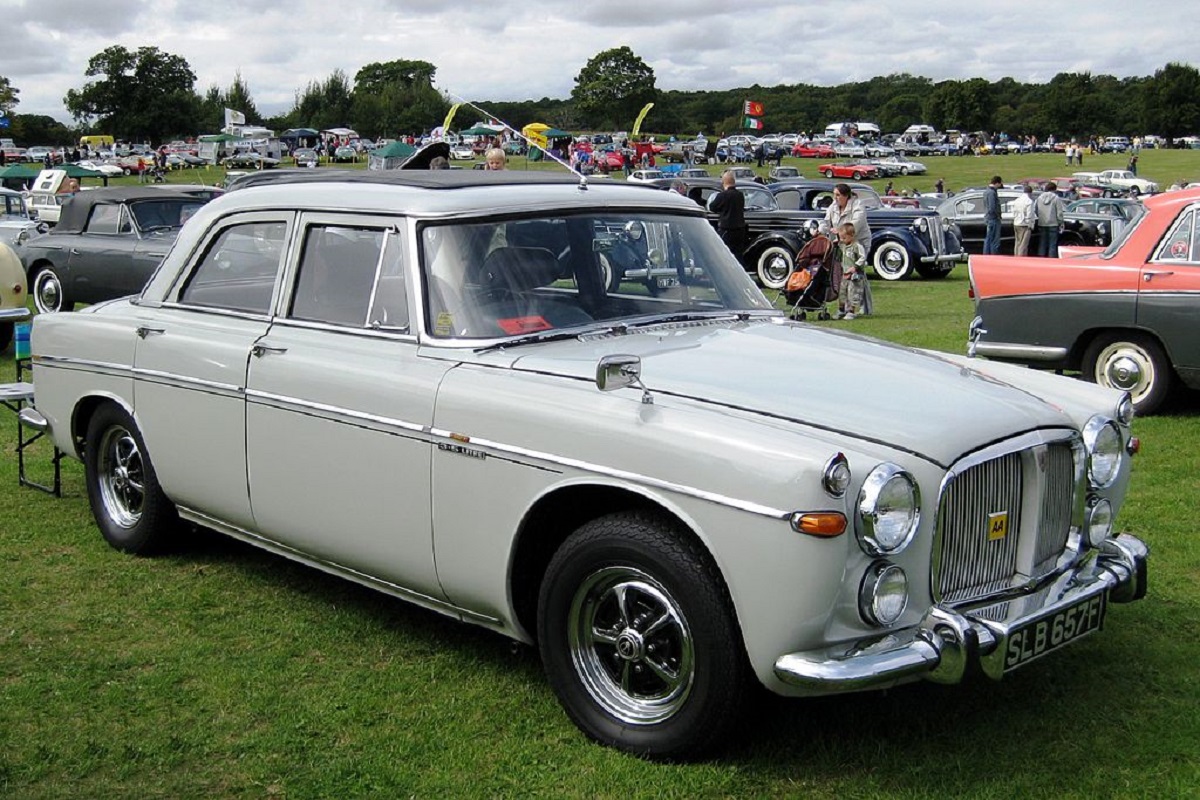
For that reason, registered relatively new-looking P5s were therefore still familiar sights in Westminster for more than a decade after production had ended.
When Margaret Thatcher entered Downing Street in 1979 after her election victory, she was driven in a 1972 model. It was during Thatcher's eleven-year tenure that the P5 was eventually phased out as a Prime-Ministerial car, in favour of the Jaguar XJ.
Queen Elizabeth II also owned an Arden Green Rover P5B Saloon "JGY 280", which is on display at the Heritage Motor Centre, Gaydon, Warwickshire and was seen in the 18 May 2003 episode of BBC motoring show Top Gear.
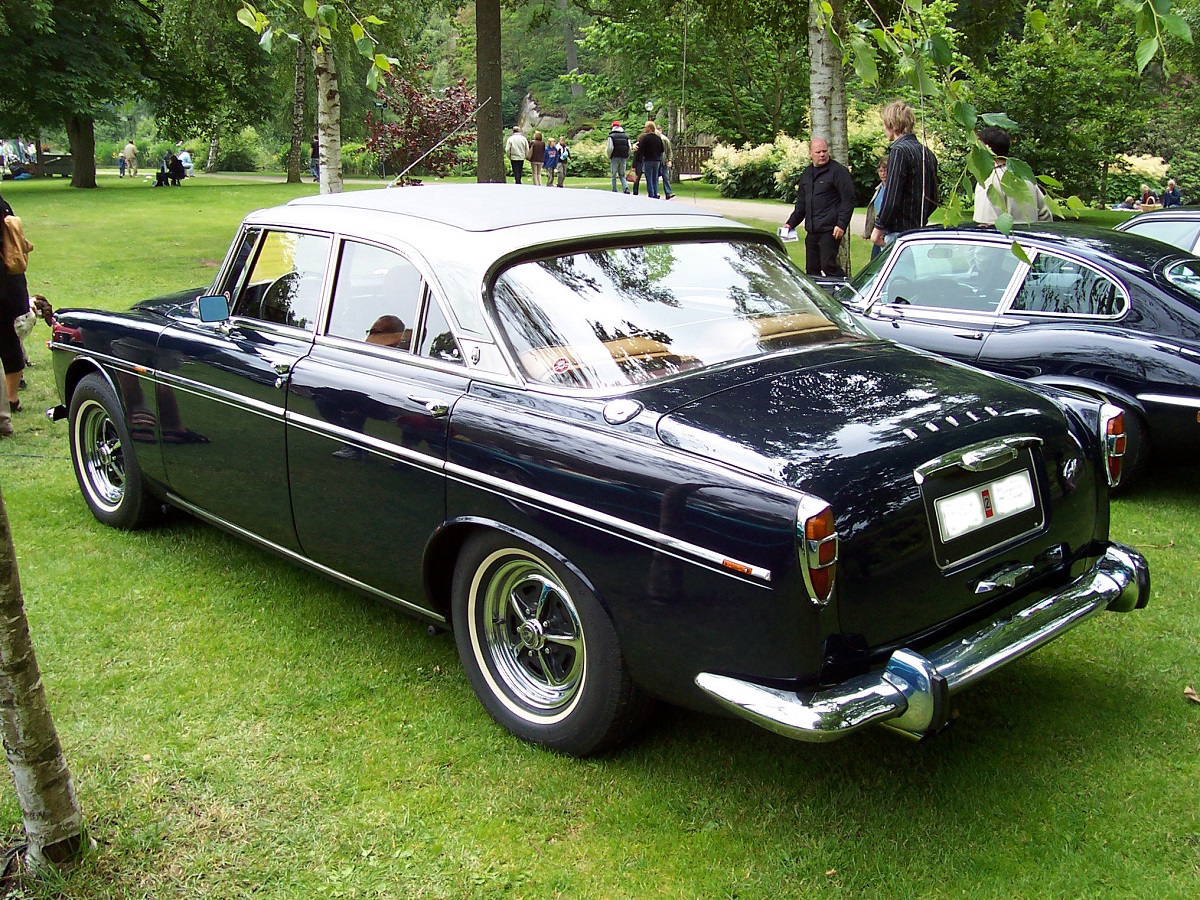
The coupé version featured a lowered roof line; shown is a P5B coupé.
Rover 3.5 Litre – saloon vs. coupé
Saloon
Coupé
Note differences in roofline, windows, and B- and C- pillars
Motorsport
The Rover P5 is sturdy enough to be a popular choice for banger racing.
A Rover P5 3-litre was the seventh of the "Magnificent Seven" finishers in the 1963 Safari Rally. One humorous theory is that the car was so heavy that it sank through the mud until it found bedrock.
Royal P5 and P5Bs
In some respects it is difficult to establish exactly how many Rover P5s Queen Elizabeth II had because she had arranged to carry forward her personal number plates JGY 280 on most of her private cars, with the exception of her last P5B which was JGY 280K.
In February 1961 the Queen took delivery of her first Rover P5 3 litre Mk 1 which was registered JGY 280 and finished in dark green. In May 1961 Her Majesty the Queen Mother took delivery of a similar 3 litre car registered VUL 4. Neither car was obviously different from standard specification, although VUL 4 did carry a discreet identifying lamp at the base of its roof mounted radio aerial and was illuminated when in use by a member of the Royal family. This was to allow the police on point duty to quickly identify and usher the Royal Rover through the traffic.
In 1963 Her Majesty took delivery of the first of two 3 Litre Mk 2 cars, the first carrying forward the personal number plate JGY 280 with the second Mk 2 being built rather later, finished in Pine Green, and registered 155 HYU. This was an additional car, not a replacement, and delivered to the Royal Estate at Sandringham and is still housed in the Royal Mews and is on display for visitors to see, among other Royal vehicles.
It is clear that Her Majesty the Queen had considered the Rover P5 her favourite car during the 1960s and when the 3-litre models were no longer available, she took delivery of her first P5B replacement. Rover records suggest that just two P5Bs were delivered for Her Majesty's personal use and both were saloons, although other P5Bs were undoubtedly used by the Royal Household more generally.
The first of these two cars was VIN 84007057D, which was finished in a special dark green (Recorded as T&N Dark Green) which she specifically requested and it was delivered towards the end of January 1971 with the registration number JGY 280.
Her Majesty's second car was also in the T&N Dark Green and was VIN 84100723D – the last P5B manufactured in 1973 but not delivered to the Queen until March 1974, as it had a number of modifications as a consequence of the Irish troubles. The Queen appears to have wanted to retain her private registration JGY 280 which had been on all of her earlier Rovers, but in fact the car was given the contemporary number of JGY 280K – presumably because that was less conspicuous for a car which Her Majesty used to drive unaccompanied on public roads. As of 1997, both cars were still owned by Her Majesty and retained at the Gaydon Motor Heritage Museum.


 LINKS E SITES IMPORTANTES


